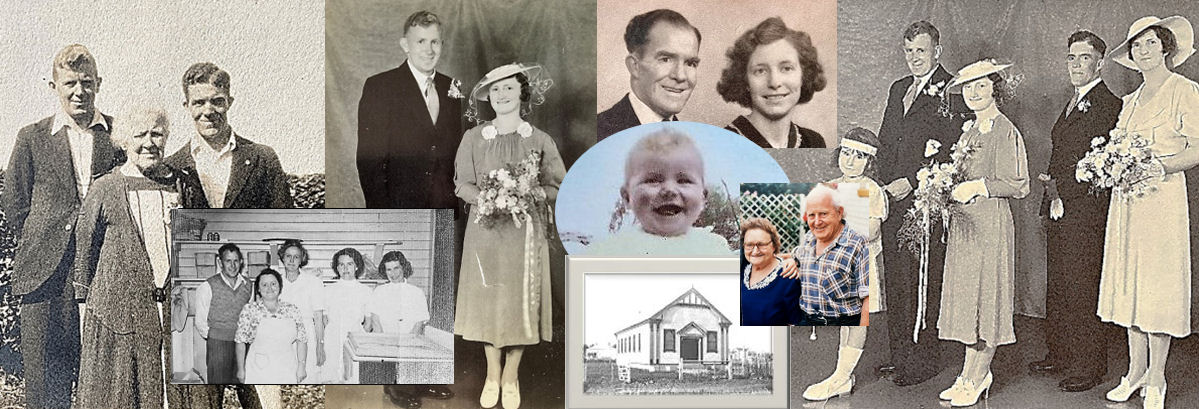
FROM BIRMINGHAM TO MORRINSVILLE–THE ANTECEDENTS OF HERBERT HENRY SKETT.
MARTIN SKETT AND MARIA (BROWN) SKETT
Martin and Maria were Dad’s Grandparents. Martin was born 1829 and died in 1893. Maria was born in 1828. So far, I haven’t uncovered her date of death. Their son, Charles Henry, who was Dad’s father, was born in Birmingham in 1858.
CHARLES HENRY SKETT 1858 – 1917
Charles Henry was Dad’s Father. He was born in January 1858 to Martin Skett and Maria in Warwickshire, Birmingham
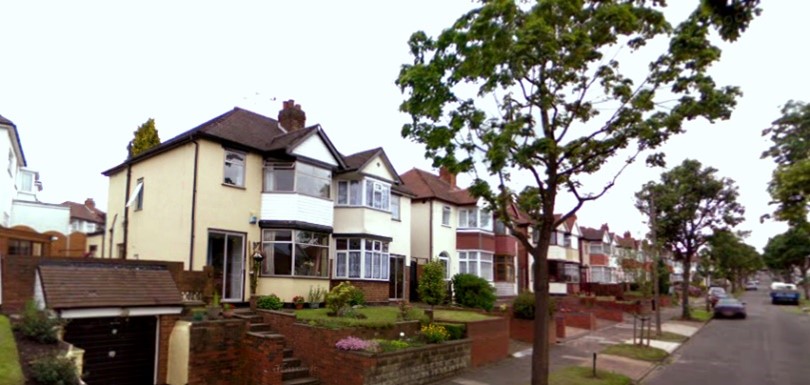
In 1885 he married Emma WOLITER. Emma was born in 1857. Charles and Emma had at least two children. In the 1891 Census they are shown as living at 2 Blakeland Road, in the Aston district of Warwickshire. If Google Maps Street View is to be believed, this is one of a row of semi-detached houses, very similar to the Clay Lane home where Cliff and Elsie later lived in Yardley. It’s appearance today would suggest the home has been extensively renovated, at least on the outside, since the family lived there! In the photo, No. 2 is the left half of the double unit in the foreground.
In the Census records those living at 2 Blakeland Road, Aston, were:
- Charles Henry SKETT, aged 33
- Emma (Anna) SKETT, aged 34
- Emma SKETT, aged 5
- Ernest SKETT, aged 1
- Emma(Charles’ Wife) died in 1901.
In 1906 Charles Henry married Alice Wright. Alice was born in 1864, (28 August) and at the time of her marriage to Charles, had at least one child from her first marriage: Florence, (‘Auntie Florrie’, later of Herald Island, Auckland), who was born on the 19th of August 1892.
ALICE WRIGHT.
Alice’s back story is complicated. The confusion arises because on various certificates Alice’s former family names are variously listed as Sutton, Chapman, Wright and Skett.
Using information in some certificates we have, and with help from Wendy Cooper, Alice’s Great-Granddaughter in Morrinsville, the following is what can be tentatively set out:
- Alice’s Mother was Mary Sutton. Mary was born in 1842. The exact date can’t be determined at this stage.
- Alice was born on 28 August 1864. Therefore Alice Sutton.
- Mary and George Chapman, who was born in July 1847, were married in April 1865. Mary was 23, George just short of 18.
Was George Chapman Alice’s Father? Quite possibly, but not certainly.
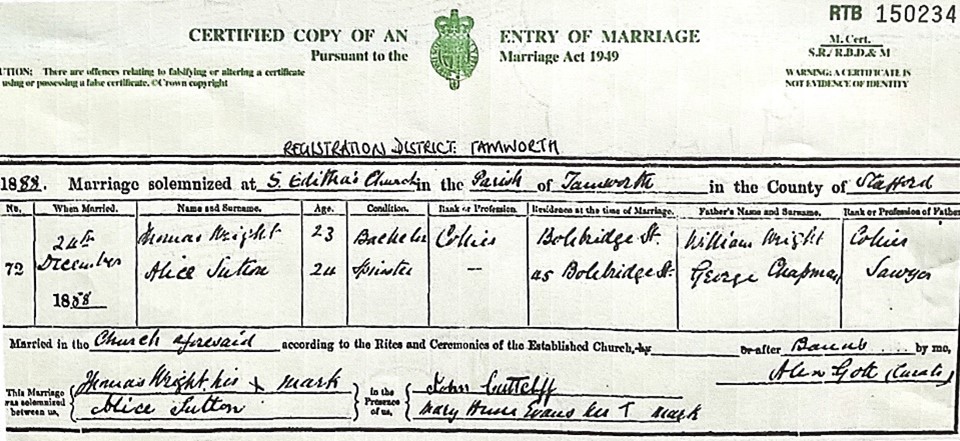
- On 24 December 1888 Alice married Thomas Wright. Thomas was 23, Alice 24. On the Marriage Certificate Alice was married as Alice Sutton. Father: George Chapman.
- On 09 September 1892, Thomas and Alice’s Daughter, Florence (no middle name) was born. On Florence’s Birth Certificate Alice is listed as “Alice Wright formerly Sutton.”
- Alice married Charles Henry Skett on 24 December 1906. She was married as Alice Wright.
- Charles and Alice’s Son, Herbert Henry Skett (Dad), was born on 25 February 1909. His Mother is listed as “Formerly Wright” on the Birth Certificate.
- Alice died in Morrinsville, New Zealand on 23 July 1938. Her maiden name, and the names of her parents are not listed.
- On 29 November 1938 Dad and Mum were married in Morrinsville New Zealand. On the Marriage Certificate Alice is shown as “Formerly Wright.”
- When Dad died on 15 December 1992, his Death Certificate shows his mother as Alice Skett, “Formerly Chapman.”
My summary: Alice was born to Mary Sutton (28 August 1864) while Mary wasn’t married, but was married 8 months later, in April 1865, to George Chapman. I suspect that Alice became known then as Alice Chapman. Or at least that some in later generations assumed that was her family name. Her name was possibly not formally changed, and when she married Thomas Wright, it was as Mary Sutton, unless ‘formerly’ should be read as ‘maiden name.’ When she married Charles Henry Skett, and when Dad married Mum, she was Wright. But then we have the reversion to her birth name of Sutton on Dad’s Death Certificate.
In the 1911 Census, Charles Henry and Alice were living at 21 Sydenham Road, Small Heath, in Birmingham. The house no longer exists, and today the site appears to be a commercial one in a street of light commercial buildings. Those living in the house at the 1911 Census were:
- Charles Henry SKETT, aged 52
- Alice SKETT, aged 46
- Emma Skett, (Charles’ Daughter) aged 25
- Ernest SKETT (Charles’ Son) aged 21
- Ivy (Sophia) SKETT (Charles and Alice’s daughter) aged 5
- Herbert H (Henry) SKETT (Charles and Alice’s Son) aged 2
At the time of the Census, April 2, 1911, Alice was pregnant with Charles Clifford (Uncle Cliff) who was born just over a month after the Census was taken, on May 17.
Charles Henry’s occupation at that census is listed as ‘Cycle Fillet’ – something to do with welding/brazing in the making of bicycle frames. But on Dad’s birth certificate he is listed as a ‘Gun Action Maker.’ Almost certainly he was employed at the BSA factory in Small Heath, as were hundreds if not thousands of others in the East Birmingham area. BSA (Birmingham Small Arms) had two very large factories: one in Sparkbrook (Montgomery Street) which is where Dad worked between August ’23 and March ’25. The other was in Armoury Road, Small Heath. The Sparkbrook factory no longer operates, but the Small Heath one does. On the personal reference Dad was given when he left, the letterhead says they made: Military Rifles, Lewis Automatic Machine Guns, Sporting and Match Rifles, The BSA Air Rifle, The WO Pattern, and other Miniature Rifles, BSA Cycle Fittings, the BSA Bicycle and Motor Bicycle, Special Machinery, Manufacturing Equipment, Small Tools. They were contracted to ‘His Majesty’s Government’, the War Office, The India Office and to ‘Colonial and Foreign Governments’!
The Sparkbrook Factory, where Dad worked 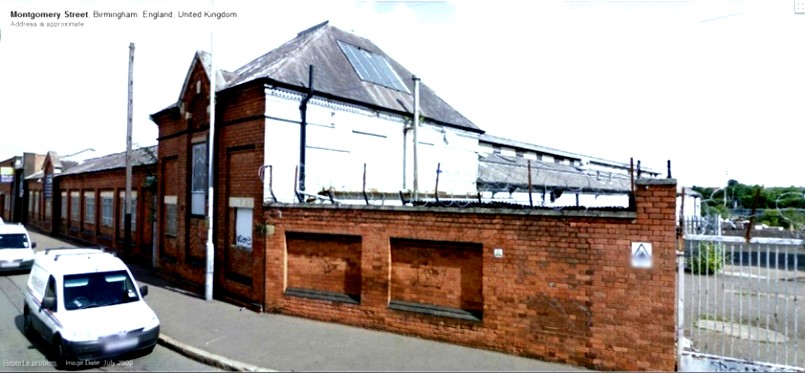 later, was only a couple of Kilometres from their Sydenham Road home – straight up Sydenham Road, across into Montgomery Street, and direct to the main gates, which were opposite the end of Dolobran Road. The photos show the frontage and gates, and a close-up of the wall stone with the ‘WD’ (War Department) inscribed.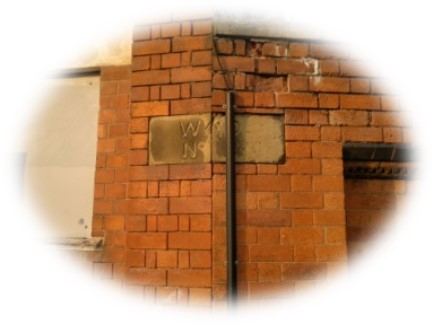
Charles Henry died towards the end of 1917. At the time of his death, Ivy would have been about 11, Dad 8 and Cliff 6. On the 26th of August the following year, Dad and Uncle Cliff were admitted to the Josiah Mason Orphanage in Birmingham.
Josiah Mason (1795-1881) was born in Kidderminster, the son 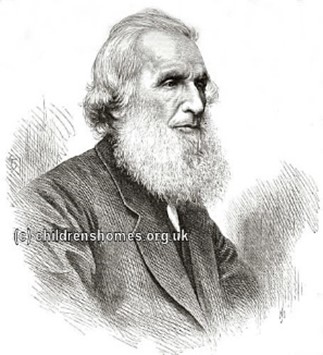 of a carpet weaver. He was largely self-educated and tried his hand a variety of trades in his native town before moving to Birmingham in 1816. There he became involved in industries such as electro-plating, keyring making, rubber ring making, and — most notably — the manufacture of steel pens and nibs through which he amassed a considerable fortune. He subsequently used much of his wealth for philanthropic purposes
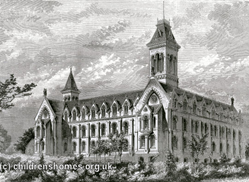 The first orphanage opened in 1858. The building originally accommodated thirty orphan girls who, in addition to a basic education, were taught baking, washing, and other domestic skills. The success of the institution led to plans which eventually evolved into a much larger institution which would accommodate 300 or more children, two-thirds of them being girls and one-third boys. Josiah Mason himself laid the foundation stone in September 1860, and the building was opened and occupied in 1868.
Boys were required to be aged from seven to ten years old at their time of admission and left when they were fourteen; girls were admitted between four and ten years old, leaving at the age of fifteen. The Orphanage seems to have been highly regarded in its time, although there are stories from former inmates about rigid strictness and firm discipline. There’s no doubt the orphanage was effective in guiding 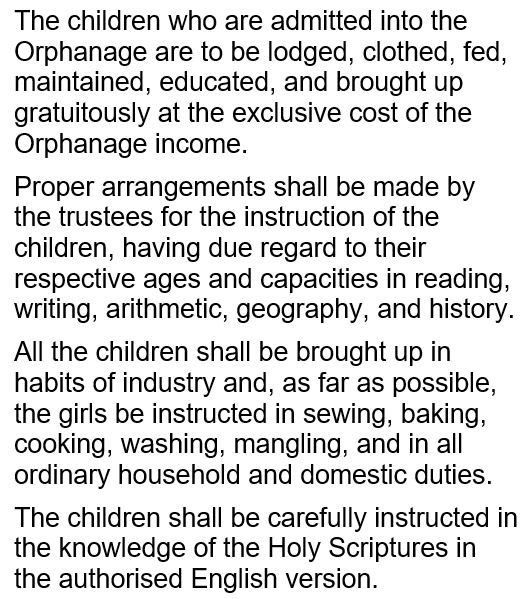 hundreds of orphans through their childhood care and education over the 96 years it operated. Following a steady decline in the number of its residents, the orphanage finally closed in 1964 and the buildings demolished to make way for a housing estate.
The orphanage had strong governing principles in what was provided for the young residents, as the attached statement makes clear. And unlike many other orphanages, Mason's demanded that candidates for admission were orphans in the strictest sense, namely that they were to be the legitimate children of parents both of whom were dead. Certificates were required of the marriage and death of the parents, and of the birth of the child. So, it’s a bit of a mystery as to how Dad and Cliff were admitted. The family should not have qualified under that principle.
Among the few pieces of printed material I have from that period is a certified copy of Dad’s Birth Certificate, obtained, I presume, by Alice in 1918, for the purposes of “elementary education.” This was required under the Factory and Workshop act 1901 which applied at the time regarding the education of children. It would have been necessary for Dad to receive teaching at the Orphanage. The act lists 8 purposes for which a certificate is required. The list includes “For admission to an orphanage or other charitable institution in which elementary education is given.” It’s dated 04 July 1918, a few months after Charles Henry died, and just before Dad and Cliff were admitted to Josiah Mason. I presume there’s one somewhere for Cliff.
A former chair of the Old Masonians Association responded as follows to my questions when I contacted them by email:
Betty said that both Dad and Cliff must have been in touch in some way because they had passed on their NZ contact address which was via Skett & Co., Studholme St, Morrinsville.
There has been a suggestion on one website that the Orphanage had played a part in arranging and facilitating the emigration of inmates. However, this was being strongly denied by a descendant of a family who had children at the Orphanage. This same website bemoaned the fact that nearly all the records of the Orphanage were destroyed when it was closed, and the buildings later demolished.
On 20 August 1923, while he was still at the Josiah Mason Orphanage, Dad went to work at the BSA Plant at Sparkbrook, Birmingham, and was employed there until 11 March 1925, just 2 days before the family sailed for New Zealand. He never talked much about the time with BSA, but skills acquired then were to stand him in good stead in later years, giving him a very good set of abilities as a handyman. At some stage during that period, he damaged the forefinger on one hand, apparently while working on a lathe. The injury never seriously hindered him either in his professional or private life.
When he left the BSA plant he was given a work reference:
"This is to certify that Herbert H Skett, late of 18 Sydenham Grove, Sydenham Road, Sparkbrook, Birmingham was employed by this company from 20.8.1923 until 11.3.1925 as a machinist at our Sparkbrook factory.
During this period we found him to be a satisfactory worker, honest and industrious and a good timekeeper.
It is contrary to the practice of this company to give open references to late employees, but this is being given to him as we understand that he is about to proceed to New Zealand."
Going by the dates given by the Old Masonians and then BSA, Dad must have gone to be with his mother in July 1924 while continuing to work at the BSA plant as he appears to have been living at home rather than at the Orphanage according to the reference BSA provided.
Dad never spoke about their time in the orphanage to me at least. And hardly ever about his childhood and youth in Birmingham.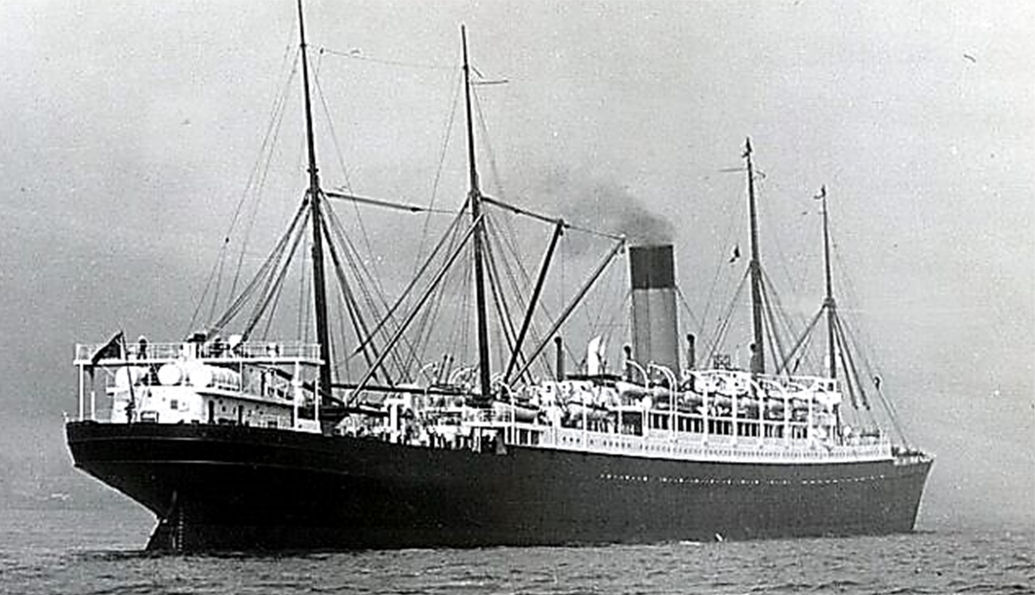 He seemed to feel that in coming to New Zealand, he’d left that part of his life behind him and had no desire to revisit it. Neither was there any desire to go back to Birmingham for a visit. After Gwenda and I visited there, we were disappointed that Dad felt like that. We think it might have erased to a small degree anyway, his negative feelings about that part of his life. On March 14th1925, Alice, with Ivy, Dad and Cliff boarded the SS Athenic at Southampton and travelled to New Zealand. They arrived there on April 22 to be met by Florence (Florrie)and Charles (Charlie) Richard SINDLEN, who were then living at St Heliers. (They would later live in Ponsonby and then on Herald (Pine) Island at the top of the Waitemata Harbour.Left: The SS Athenic (White Star & Shaw Savill Lines), provided passenger and cargo services to and from New Zealand (1901 - 1928).
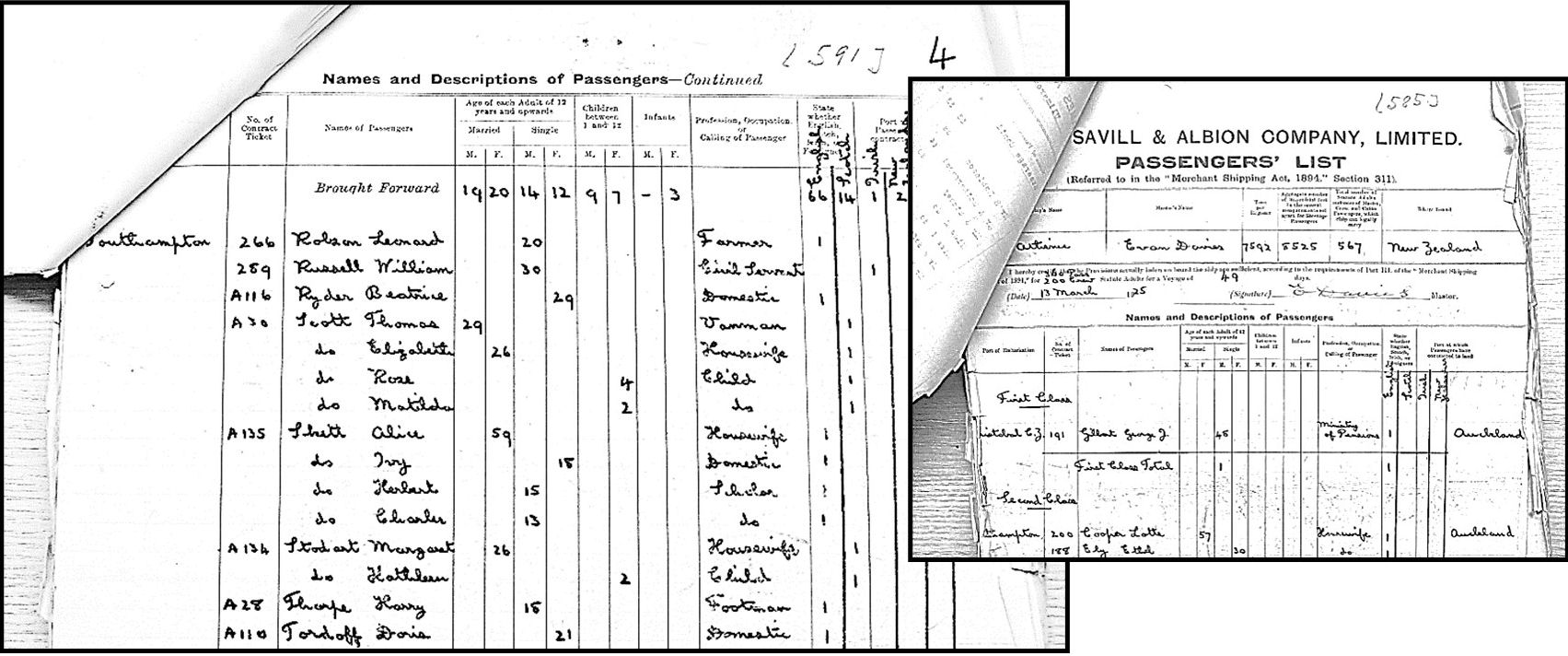
13/03/1925: Left Birmingham at midnight by bus, arriving in London at 3am. Then went by tube from Paddington to Waterloo. Tripped around London by bus until it was time to catch the boat train from Waterloo at 9am. For Southampton, arriving midday.
Sailed on the SS Athenic at 2pm (14 March, 1925) to Panama Canal, and disembarked at Colon for 2-3 hours, re-boarding to sail through the Canal. This took 5 hours, reaching Balboa, and then by sea to Pitcairn Island.
Arrived Auckland Tuesday 22/04/1925. Met by Florrie (half-Sister) and husband Charlie Sindlen and taken by bus to St Heliers, via Newmarket, Remuera and Meadowbank.
They lived with Florrie and Charlie for two weeks, and rented a house from a Mr WH Andrews, Vale Road, St Heliers.
Herbert (Bert) went to work for the Bycroft Biscuit Factory. Ivy worked at the Colonial Ammunitions Factory. Charles (Cliff) found employment at either the Post Office or a grocery store.
Dad’s niece, Edna Johansen, passed on some notes she had recorded during a conversation with either Dad or her mother Ivy, describing the journey to New Zealand, and their arrival
Raymond recalls that Dad said he didn’t know of Florence’s existence before they arrived in Auckland. This is possible as Florence seems to have stayed with her father when Thomas and Alice parted. At this stage we must assume that there was a divorce to allow Alice to marry Charles Henry Skett later.
When Thomas went to Australia sometime after the divorce, Florence went with him. Thomas remarried there, and Florence’s Daughter, Alice (German) commented that her mother had said that Thomas’s new Wife was ‘not very nice’ to her. Florence was married in Australia to Charles (Charlie) Sindlen. They had a daughter there, who died as an infant. Charlie and Florrie returned to New Zealand at some point before 1925, as they met Alice and her 3 children when they Arrived in Auckland.
Florence died in Auckland in 1978, aged 87, and Charles two years later in 1980, aged 91.
I do know that sometime later, and I’m not sure how much later, Dad went to work for Jimmy Shoebridge, a Baker in St Heliers. On one occasion when Dad and Mum were in Auckland, we drove along the main waterfront drive in St Heliers, and he pointed out the building where the bakery was.
IVY AND CLIFF
Ivy married Richard Samuel Arthur (Dick) Johnson in September 1926 which was only 18 months after the family arrived in NZ. The wedding took place in St Heliers. Dick is described on his death certificate as a ‘gunsmith,’ although at the time he met Ivy he was an insurance agent. Ivy and Dick lived in Te Kuiti and Tauhei early in their married life, then Morrinsville. The house at the top of Studholme Street eventually became the family home.
Dick and Ivy had 10 children: Joy Gwendoline, Edna Joan, Ivy Florence, Bertrand Richard, Sadie Mary, Patricia Myra, Clifton Peter, Maureen Cecilia, Elaine Cosmos and Carol Leola. Sadly, Elaine died in January 1942, aged 4 months.
Ivy Sophia died in September 1947, and Richard Samuel Arthur in February 1955. A few months after Ivy’s death, Mum & Dad adopted Carol. Her family name was changed to Skett at adoption.
Cliff was called up in the army during WW2, but there’s no clarity about when he left NZ. In both the 1946 and 1949 electoral rolls he is listed as being at Studholme Street, but of course his name wouldn’t necessarily have been removed during his time overseas. I can’t find the 1943 rolls. Peter Skett says that …
Among a small amount of ‘bits and pieces’ I’ve inherited from the family in the 40’s, are 2 items of interest:
- A receipt provided to Dad for 12 shillings, dated 28 July 1944, for 3 boxes of chocolates “to be included in my quarterly parcel for the above prisoner.” The prisoner number isn’t included, but we have it from the second item.
- In the middle of August 1944, Dad and Mum received the following in a letter from the NZ Military Forces Base Records:
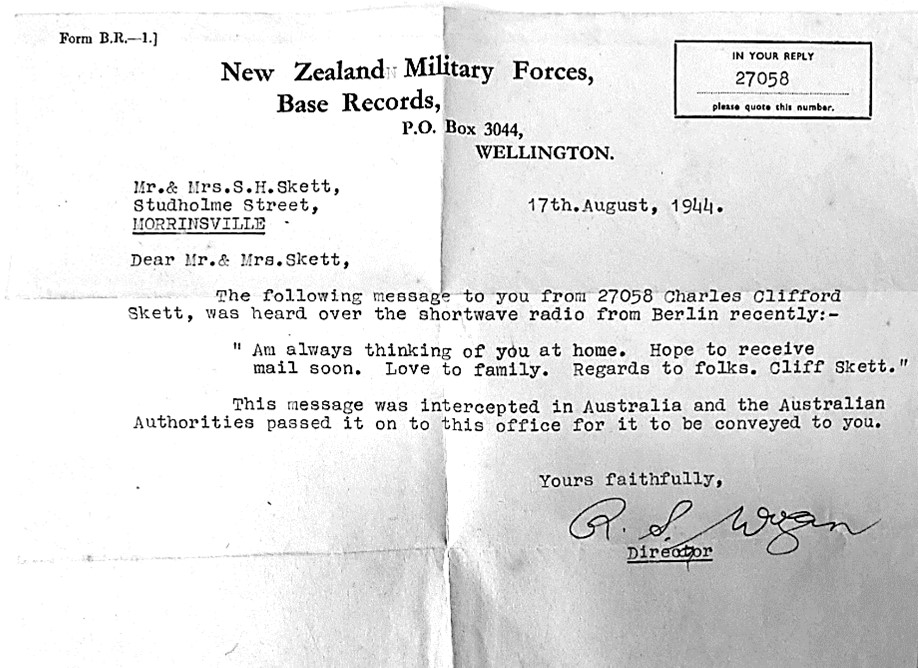
Cliff returned to NZ after the war. I remember Dad telling me he went over to Frankton Junction to meet him off the train. As they drove back to Morrinsville in thick fog, Dad said, he was having to keep going by focussing out the driver’s window at the centreline. Just out of Hamilton, Dad took the wrong road at the Y-junction. Quite quickly Cliff announced they were going in the wrong direction!
I only vaguely remember Cliff being with us in the old Studholme Street house. Apparently, he and I shared the bedroom off the kitchen there. Cliff left to return to England when I was 7 or 8. Peter, his son, says:
"As a child, I always thought that Dad had stayed in England after he was demobilised. 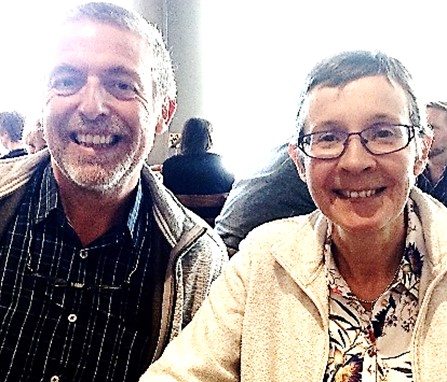 However, from something he said before he died, I believe he was back in New Zealand immediately after the war only to return to England later. I think that may have been in 1948, but I’m not sure. Before Dad worked for Lucas, he worked in an orphanage. It was during that time that he met Mom."
Raymond says: "I would say 1948 is very likely, as I have a memory of Cliff waving to us from the Edwards Motors bus as it drove up Studholme St past our old house heading north to Auckland. I would have been almost 5 years old then."
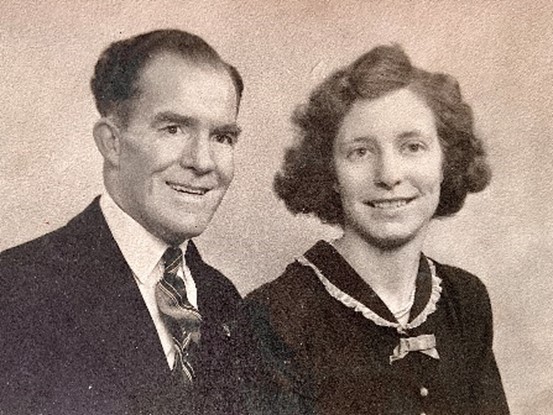 Cliff and Elsie (Screen) were married in Birmingham on the 1st of September 1951. Cliff died in October 1995. Elsie died on the 6th of January 2010. They had 3 boys – David (October 1952) and twins Peter and John, in September 1957. Peter and his Wife Jenny have been to New Zealand twice and met with members of our family on both occasions. Both Marlene and Raymond in 1977, and Alice and Rob at Christmas 1985, visited Cliff and Elsie in Birmingham, as did Gwenda and I in the Summer of 1994. Alice and Rob visited again some years later after Cliff had died.
Some time between the late 1920’s and the early 1930’s, Alice, Dad and Cliff moved to Morrinsville. Their story is taken up in the "Sketts in Morrinsville" narrative. Mum's story can be found in the "Johnston" narrative.The Sketts in Morrinsville
(Pearl & Bert)
Ft Garry to Morrinsville
(The Johnstons)
Skett/Johnston Family, Morrinsvile, New Zealand/Aotearoa
- «
- 1Introduction
- 2From Fort Gary, Canada to Morrinsvile, NZ
- 3From Birmingham, UK to Morrinsville, NZ
- 4Pearl & Bert in Morrinsville
- 5Photographs of Morrinsville
- »