FORT DOUGLAS TO MORRINSVILLE: THE ANTECEDENTS OF AGNES PEARL SKETT.
ROBERT SHIELDS IN CANADA.
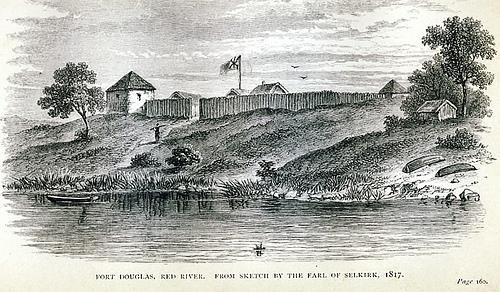
The Fort Douglas Settlement
In 1811 Lord Selkirk started sending ship loads of settlers to the Red River Settlement in North America. To govern this new colony he chose Miles Macdonell, a Canadian whom he had met in Scotland. A number of these people were evicted Highlanders, the victims of Highland clearances. The first settlers left their homeland on 26 July 1811, aboard two Hudson's Bay Company ships, the "Prince of Wales" and the "Eddystone” along with a third ship, the "Edward and Ann"
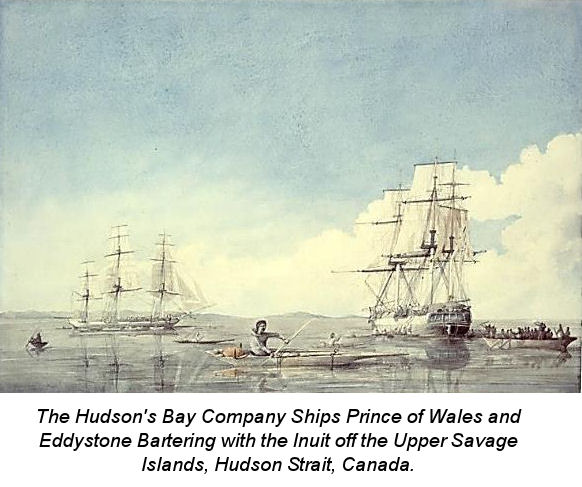 They arrived at York Factory, Hudson's Bay on 24 September 1811. Having taken longer than expected to cross the Atlantic, they were too late to press on to Red River before the onset of winter. They were forced to make a winter camp on the banks of the Nelson River. This was a very bad winter and provisions were in short supply. Owing to the snow, the wild game had left the area and fresh meat was non-existent. It was well into the spring before the first deer came within the range of a gun and added a change from salt meat on the menu. The ice was late breaking up that year and the new arrivals were forced to wait until 16 July before starting on the last stage of their journey to their new home Almost a year had passed since leaving Scotland and there was still 700 miles to travel into the centre of a strange country taking all their possessions with them. The new settlement, which became Fort Douglas, was established at the junction of the Red and Assiniboia Rivers. This site is now very near what is the centre of Winnipeg.
Robert and Mary (Brown) Shields.
In 1819, Robert Shields and Mary Brown were both passengers on the “Prince of Wales” emigrating to Canada, heading for the Fort Douglas settlement. It’s not known whether Robert and Mary knew each other before this journey.
This is part of a letter which is printed with the permission of the Hudson’s Bay Company's Archives in London:
"Robert Shields took passage for Hudson Bay in 1819 on the Hudson's Bay Company ship "Prince of Wales" (Captain John Davidson) He is listed in the log as a Scotch settler, embarking on 22 May 1819 at Gravesend. His age is given as 20 and his capacity as a labourer.
On the same ship was Mary Brown, aged 18 described as one of three single girls. The passengers disembarked at York Factory, 31 Aug 1819." — (H.B.C. ARCH NO Cl/788)
The next information of him is his marriage recorded in several family bibles here in New Zealand:
"Robert Shields and Mary Brown were married Fort Douglas, Kildonan Settlement, North America, 24.12. 1819. Robert Logan, Minister."
 No certificate or official record has been found of this marriage in 1819 but all the evidence gathered points to it as a fact. Firstly, the Mary Brown of the "Prince of Wales" mentioned above is the most probable Mary to have married Robert as it is most unlikely there would have been another girl of the same name and age in the small settlement of Red River. Most settlers were either families or single men and there were very few single girls.
The return to England, and then to Scotland.
With 2 of their children, Robert and Mary returned to England on the “Prince of Wales” on September 12, 1824, arriving in London on November 1. At some stage after that they moved to Scotland, and they both died in Edinburgh. Mary in 1850, and Robert in 1860. Robert and Mary were Mum’s paternal great-great-grandparents.
John and Elizabeth migrate to New Zealand.
John was the 2nd child of Robert and Mary Shields. He was born at Fort Douglas in December 1823. He travelled to England with his parents in September 1824, and then to Scotland. He and Elizabeth were married in Edinburgh. In May 1848 they emigrated to New Zealand. They were Mum’s paternal Great-grandparents.
Extracts from an article about migration ships to New Zealand by John Wilson:
"The Voyage Out" – Te Ara, the Encyclopedia of New Zealand, February 2005.
Embarkation
The journey to New Zealand began for most migrants with an overland trip to the English ports of London or Plymouth, or to Greenock docks near Glasgow. Passengers embarked knowing they were leaving their native land and often their loved ones, perhaps never to return. An 1841 emigrant recorded that no one was in a talkative humour as they took ‘a last long aching gaze’ at their native shore but noted later that ‘the hope of the future’ drove regret away.
Assisted immigrants
Some immigrants paid for their own passages, but many had their fares paid by colonisation companies or the government. They travelled in steerage – a low-ceilinged space beneath the main deck. Those paying their own way were usually in ‘second’ or ‘intermediate’ cabins, or in a saloon cabin below the poop deck, at the stern. In 1866 the cheapest saloon fare was more than three times that of steerage. Steerage passengers generally outnumbered those in the cabins by 10 to 1. (The passenger list for the voyage of the “Jura” which brought members of the Johnston family to New Zealand in 1858, lists 7 passengers in cabins, and 216 adults and 156 children in steerage.)
Conditions in steerage
Writing of the conditions in steerage, one cabin passenger commented, ‘Poor creatures, it is a horrible place between decks, so many people in so small a space, I wonder how they live’. Steerage passengers slept in tiers of bunks. They were provided with mattresses, but not bedding. Bunk space was cramped, and tables and forms occupied the spaces between tiers. The headroom between decks could be as little as 1.8 metres. Steerage was divided into three compartments: single men occupied the forward area, next to the crew’s quarters; single women were aft; and married couples were in the middle. Separate hatchways gave access to each compartment. Pests and Vermin infested the immigrant ships. The Charlotte Jane’s shipboard newspaper was called the Cockroach in honour of those troublesome pests. Smells emanated from the latrines and from animals on board. The steerage compartments were subject to flooding when waves broke over the ship.
Food and diet
Live sheep, pigs and poultry were carried and killed periodically to provide fresh meat for the cabin passengers’ table, where fresh milk was also served. Those in steerage survived on salted and preserved meat, ship’s biscuit, flour, oatmeal, and dried potatoes. The diet was coarse, monotonous, and offered poor nutrition, but it rarely ran short.
Child mortality
Those who died were generally children. In the 1860s and 1870s, one in five of the infants below the age of one died on the voyage. Births on the voyage seldom outnumbered deaths.
The Voyage
Usually took about 13 weeks and was a most uncomfortable experience. The food on board was both meagre and poor and had they not brought some food of their own, they would have fared badly. Ship’s biscuits, bully beef and preserved potatoes were the chief items of diet. One member of a migrating family said that her grandmother told her that her daughter, the writer’s mother, then aged 4, nearly starved. She would sit with her finger in the corner of her mouth and say, ‘I can’t eat “serbed taters” (preserved potatoes)’, but her parents kept her up after the others were in bed and fed her on the food, they had brought with them, and she managed to survive. After a dreary 13 weeks voyage, they arrived in Lyttleton on 6 December 1859.
From New Edinburgh to Otago
The planned settlement on the shores of Otago Harbour was to be called New Edinburgh, reflecting its Scottish origins. But instead, the name Otago was adopted, a version of Ōtākou, the name of the Māori pa near the entrance to the harbour.
Two Scots, George Rennie and William Cargill, were early promoters of settlement. They allied themselves with members of the Free Church of Scotland, a movement of ministers and their congregations who had left the established church in 1843 in a move towards lay control.
The plan eventually took off in 1847 when the New Zealand Company gained legal title to the Otago block, which it had bought in 1844 for £2,400. Though the name New Edinburgh was foregone in favour of Otago, the new town was called Dunedin – a Gaelic version of Edinburgh.
John and Elizabeth Shields
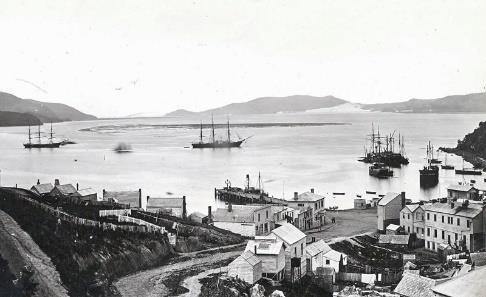
John and Elizabeth Shields were the first of the family to migrate to New Zealand. They, and their oldest child, Agnes, sailed from Greenock on 4 May 1848. They arrived on the “Blundell”, one of the first four ships coming to the new settlement of Otago, on 21 September 1848. Their first home was in the barracks in Rattray Street, Dunedin. Their second child Mary was born there.
John and his family moved to Shields Hill (present-day Shiel Hill) onto a small holding 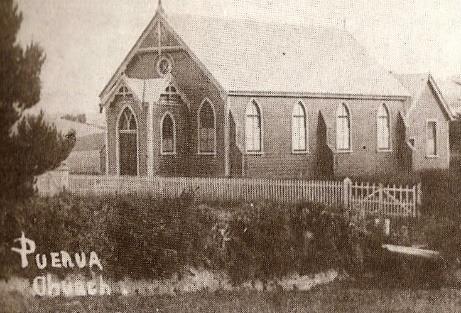 which he disposed of in 1851 and moved back into Dunedin. John took employment in 1854 in Inch Clutha working for Mr Clapcott and in 1857 he moved to his own farm at Puerua, adding to his holding in 1859. He lost his life in a drowning accident at Warepa on 29 January 1865. He is buried in Romahapa Cemetery. Elizabeth spent her life at Puerua and in later years lived across the road from the Puerua Church. Part of the house still stands and is being used as a haybarn. She lived to the age of 83 and is buried with her husband. They had a family of four sons and four daughters.
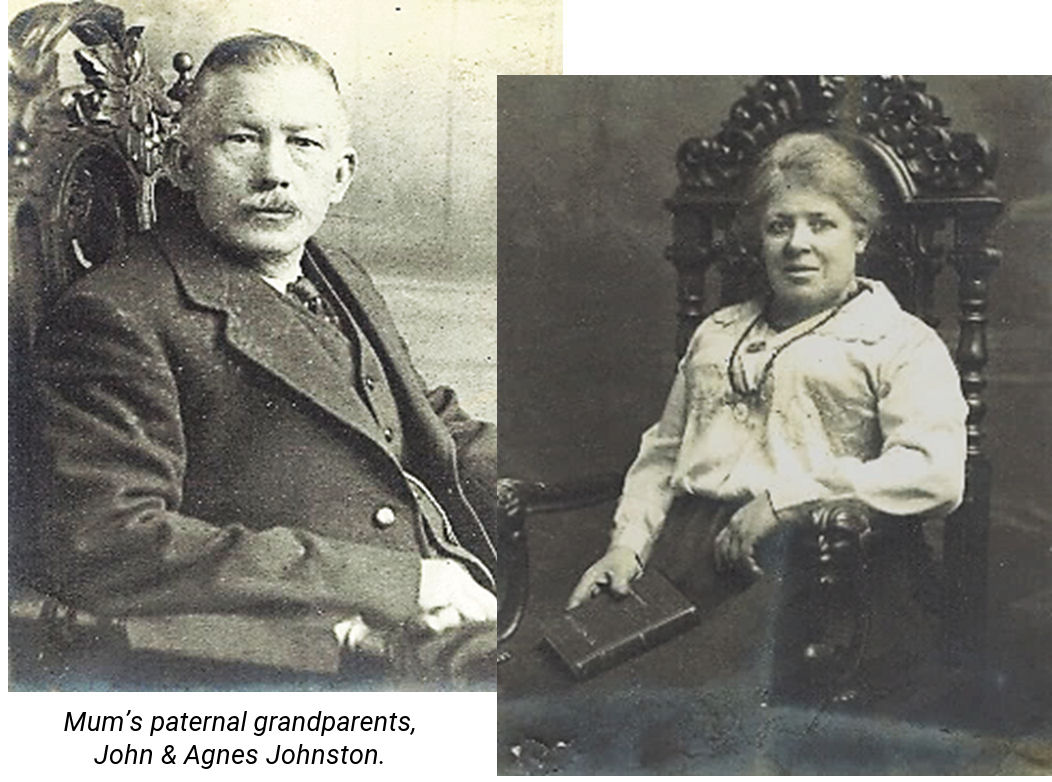
John and Agnes (Shields) Johnston.
John Johnston’s parents, Alexander and Margaret Johnston, came to New Zealand on the ship “Jura” in 1858. She sailed from Glasgow and arrived at Port Chalmers on 23 June 1858 after a 92 day voyage.
According to the passenger list published in the Otago Daily Time a day or two after the Jura’s arrival, there were 251 adults, 106 children aged between 1 and 12, and 18 infants. “Total number of 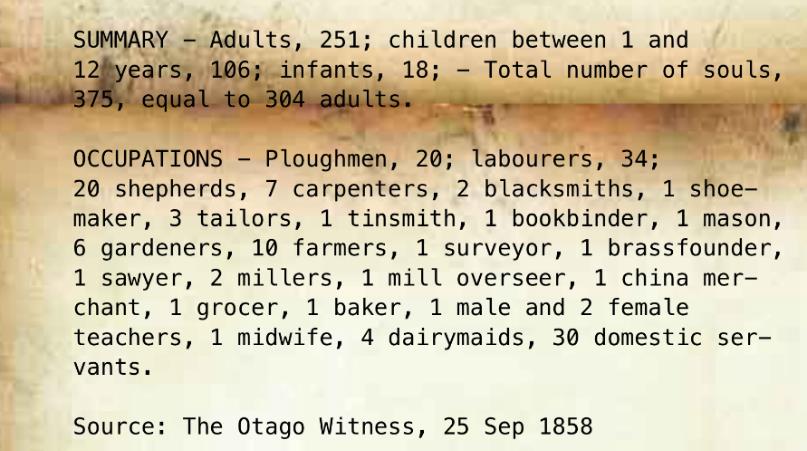 souls: 375.” Just 7 of those were in cabins, the rest in steerage. What it must have been like with that number of passengers in such not-too-large spaces for 3 months at sea we can barely imagine. A far cry from modern-day cruise liners! There’s also an interesting categorisation of the occupations of the immigrants.
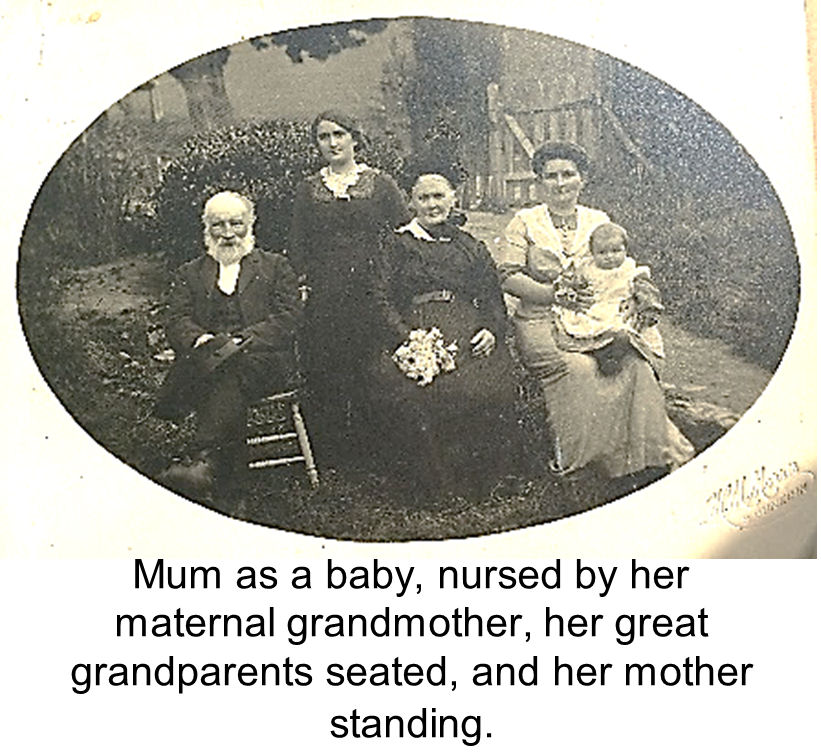
The Johnstons named the farm they bought at Romahapa “Jura” after the ship on which they came to New Zealand, and it was there that John Johnston and Agnes, John and Elizabeth Shields’ oldest child, (born 11 December 1846), were married on 19 June 1868. Their 5th child, James Alexander, was Mum’s father.
James Alexander and Jeannie (Stewart) Johnston – Mum’s parents.
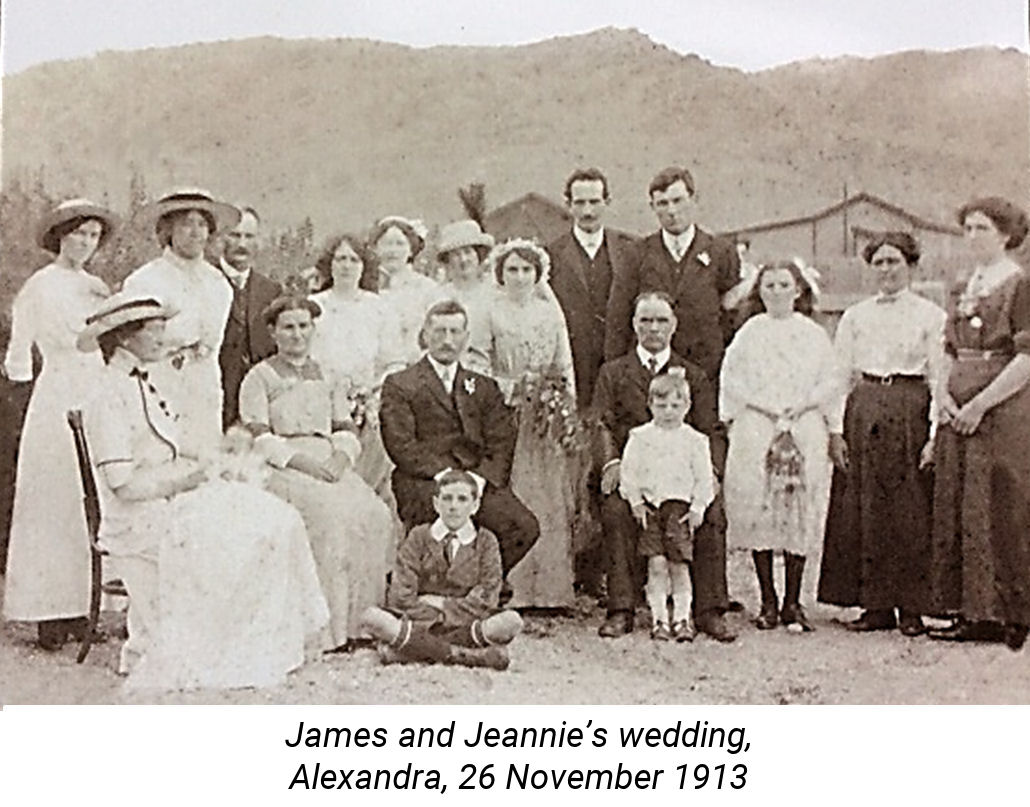
John and Agnes’ 3rd Son, James Alexander, (born 16 April 1883), married Jane (Jeannie) Stewart at Alexandra on November 26 1913. I have been unable thus far to discover any of Jeannie’s back-story. James and Jeannie were Mum’s parents. Agnes Pearl Johnston was born at Kakapuaka, South Otago, on 23 June 1914.
 James is described on Pearl’s birth certificate as a ‘Surfaceman New Zealand Railways.’ As such he would have been in a group of Surfacemen, under the leadership of a Ganger, who were responsible for the maintenance of the tracks. These gangs were also used in the construction of new tracks, as was the case with James Alexander in both South Otago and later Northland.
An article describing the work of such gangs includes this paragraph
The Maintenance Branch: As a train roars by a hillside there is a lonely railway cottage with the chimney smoking at five in the morning.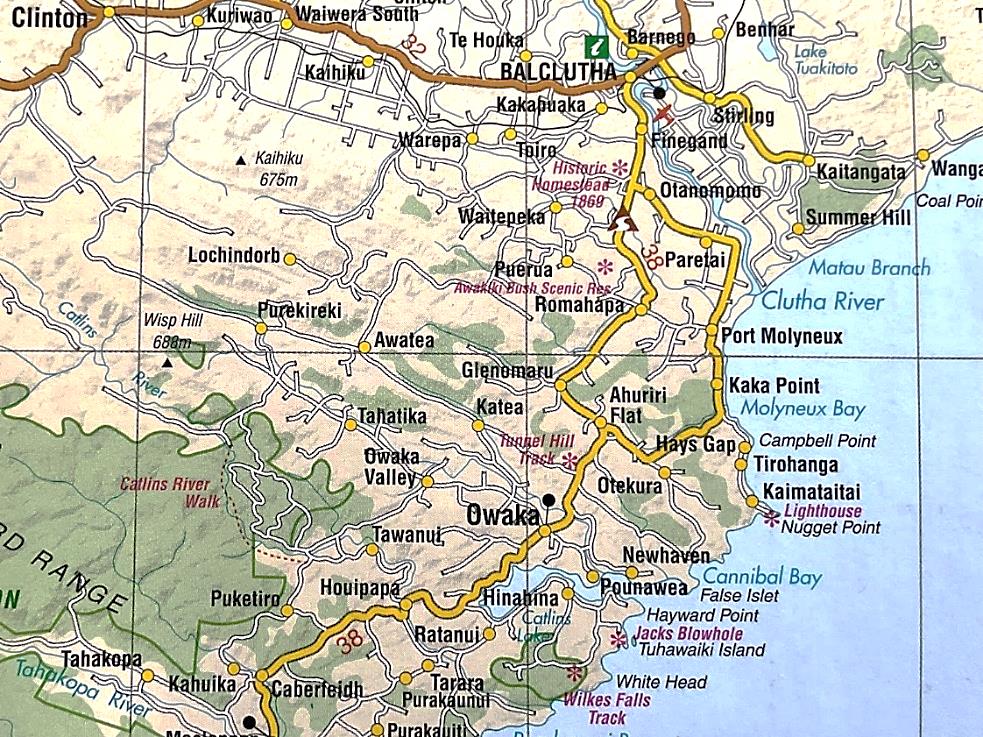 You can place that as the spot where a ganger lives. Under him are half a dozen or so surfacemen. These are the unnoticed heroes who watch for a sliver off a rail, look after the condition of fishbolts, plates and spikes, care for the joints and rail fastenings, the clearances, and clear the drains and mend the fences. They cluster most thickly where the curves are worst. It should be mentioned here that New Zealand has more curves in its railway system than any land on earth, and curves are sources of endless trouble. The All Blacks of this force are the relay gangs; and there are, of course, the specialists such as bridgemen and carpenters. The former have to clamber about viaducts and bridges, testing for faults and making, in mid-air, the necessary repairs."
It seems that in his late teens or early 20’s James started work with NZ Railways as a Surfaceman. The 68.5Km branch line from Balclutha, to ultimately reach Tahakopa, South West of Owaka, was being constructed.
The work started in 1879 and was completed in 7 stages: the first to Romahapa, then successively to Glenomaru, Tahora, Owaka, Ratanui, Houipapa with the final section to Tahakopa opened in 1915. The line was constructed to cope with the growing logging trade and became a busy one. In the early 1900’s as many as 16 trains a week ran through Romahapa.
NORTHLAND
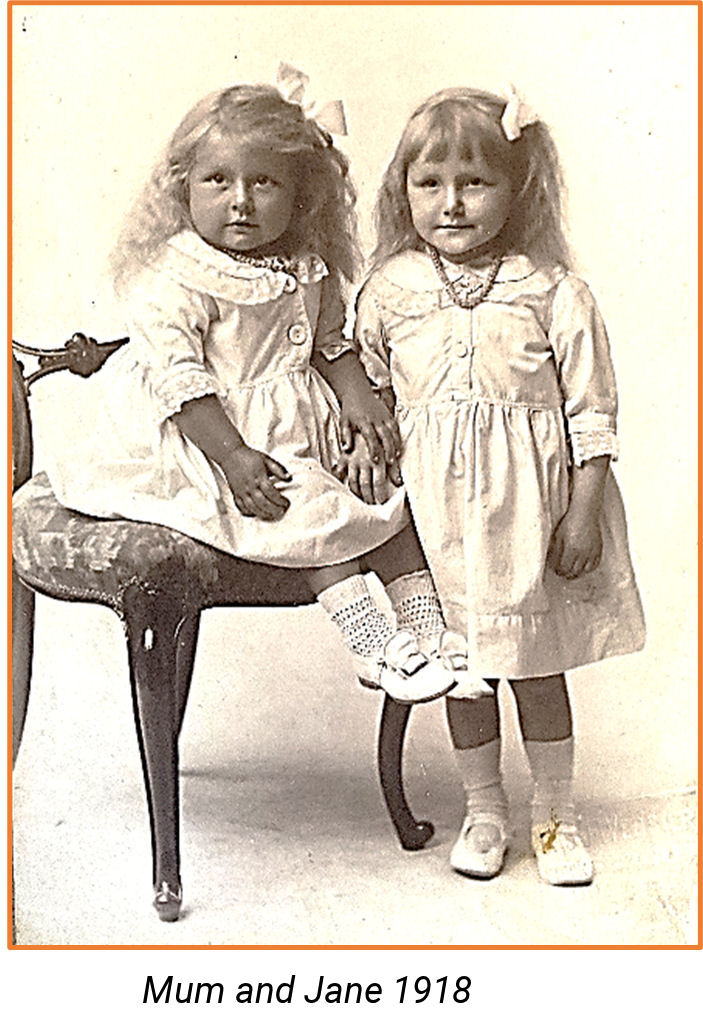 We know that the Johnston family were in South Otago until at least 1923 when Mum’s brother James (Johnny) was born in Milton. Then they were in Northland when her sister Valmai was born in Whangarei in March 1932. So somewhere in that period 1923 to 1932, the family moved to Northland. Mum’s adopted brother Maurice was born on October 5, 1933, in Grey Lynn Auckland. His birth certificate records Mum’s sister, Jane, as his mother, and that he was adopted by Jane’s parents and raised as their son.
We understand that when the move North happened, Mum’s maternal grandmother, Agnes Stewart, wanted to keep Mum in South Otago. But James and Jeannie insisted she went to Northland with them. Mum left the impression with some members of the family that her grandmother treated her more lovingly and kindly than her own parents. She always felt that her father didn’t care for her, and treated her in an off-hand, distant manner. There was the suggestion that her uncle, Thomas, was her father, and not James Alexander. While unverified, this suggestion certainly had currency within the family, and could well explain James’ attitude towards her, and her family.
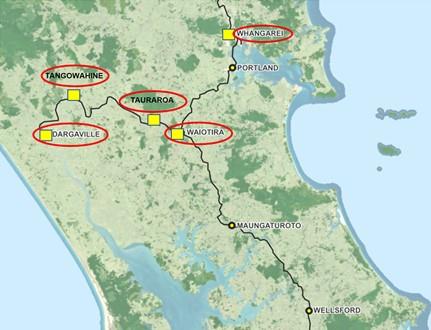 Valmai’s birth certificate records that her parents were living in Tauraroa, a rural location South West of Whangarei. Most likely, James was transferred North to work on the Dargaville Branch line being constructed between Waiotira Junction, South of Whangarei on the Northland Railway Line, and Dargaville. Tauraroa is a small rural location just a few Km West of Waiotira on that line.
Construction of the line began in 1922, but Dargaville was not reached for another eighteen years.
The first twenty-two kilometres through unstable country took six years to build, with the line not 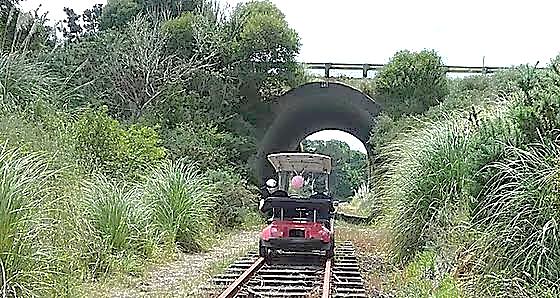 opened to Kirikopuni until 15 May 1928. In January 1931, the line was open to Tangowahine, sixteen kilometres from Dargaville, but construction ceased for five years due to the Great Depression. In 1940, trains commenced running to Dargaville, but the old railway station (used by the Donnelly's Crossing Section) was closed, and a new station built at a different location, delaying the formal opening of the Dargaville Branch until 15 March 1943, over twenty years after construction began. This line is no longer being used except for rail cart tours from Waiotira to Tangowahine.
The Dargaville and Kaihu Valley/Donnellys Crossing lines were built to freight logs from the Kaihu forest area right through to Auckland. On both Valmai’s and Maurice’s birth certificate James is listed as a Ganger, and almost certainly he was employed by NZ Railways to work on the construction of these lines. I recall Mum talking about Donnellys Crossing, but it’s unclear whether the family were located there at any stage of their time in the North.
THE MOVE TO MORRINSVILLE.
- The Johnstons: It’s my feeling that the ceasing of the construction of the Dargaville/Donnellys Crossing branch line due to the Great Depression in the early 1930s was why the family moved to Morrinsville, sometime between mid-April 1932 (Valmai’s birth) and mid -1935 (Waikato electoral roll). But we don’t, at this stage, have a definite date.
- The Sketts: Probably in the late 20’s or early 30’s Alice, Dad and Cliff moved to Morrinsville.
THE STORY OF MUM AND DAD MEETING, MARRYING, RAISING A FAMILY AND RUNNING A BUSINESS ENTERPRISE IN MORRINSVILLE, IS TAKEN UP IN ANOTHER NARRATIVE. The Sketts in Morrinsville
(Pearl & Bert)